How AI changed every industry in 2026 (so far)
From layoffs and IPOs to health records, ads and court fights, here is how 2026's biggest AI stories hit each industry.
AI news in 2026 moved fast, and most of it was not just about tech. It touched jobs, savings, doctors' offices, classrooms, ads and courtrooms. Below we sorted the year's biggest stories, January to October, by the industry they hit hardest, so you can jump to the part that matters to you. Every item links to the original report.
Jobs & Careers
The clearest change this year: big employers started saying out loud that AI means fewer office jobs.
- Amazon cut about 30,000 office jobs in two rounds. The January cut of 16,000 came three months after 14,000 in October, about 10% of its corporate staff. CEO Andy Jassy had already said AI would shrink office headcount. CNBC
- Meta cut 10% of its staff, about 8,000 people, in April, and dropped plans to fill 6,000 open roles. It also moved content moderation from contractors to AI, and Microsoft offered its first-ever voluntary buyouts the same week. CNBC
- AI started doing whole tasks, not just answering questions. Claude Opus 4.6 in February pushed what Anthropic called "vibe working," and in March GPT-5.4 scored a record 83% on a test comparing AI to professionals on real job tasks. CNBC, TechCrunch
- Data centers are creating construction work. OpenAI said its Nvidia-backed Ohio data center will support 35,000 construction jobs through 2032 and 2,500 long-term jobs. CNBC
Takeaway: Office roles built on routine research, drafting and analysis are most exposed. Learning to direct AI tools in your own field is the safest bet.
Finance
AI became the biggest story on Wall Street, from record fundraising to the largest stock debut ever.
- Software stocks crashed on AI fears in February. New Claude Cowork plugins for legal, finance and sales sent Thomson Reuters down nearly 16% in one day, its worst drop on record. CNN
- Record private funding. OpenAI raised $122 billion at an $852 billion value in March, and let individual investors in through banks for the first time. Anthropic then raised $65 billion at $965 billion in May, passing OpenAI. CNBC, CNBC
- The IPO wave. Anthropic and OpenAI both filed confidentially to go public in June. SpaceX, now owner of xAI, raised $75 billion in the largest IPO ever. TechCrunch, CNBC
- Chip money keeps flowing. Nvidia forecast $1 trillion in orders for its newest chips through 2027, then agreed to provide up to $105 billion in financing for OpenAI's Ohio data center. CNBC, CNBC
- October reality check. OpenAI's revenue pace came in near $50 billion, below a widely reported $68 billion, and Oracle fell nearly 6%. Anthropic began sharing quarterly numbers with investors ahead of a possible listing. CNBC, CNBC
Takeaway: If you own index funds or a retirement account, you already have exposure to AI. Expect big swings when AI companies report numbers.
Healthcare
- ChatGPT Health launched in January. OpenAI said more than 230 million people ask ChatGPT health questions each week. The new space can connect apps like Apple Health and MyFitnessPal, and OpenAI says it won't train on those chats. Its own terms still say it is not meant for diagnosis or treatment. TechCrunch
- AI research could reach medicine. When an OpenAI model disproved a 1946 math conjecture in May, checked by outside mathematicians, OpenAI said the same reasoning skills matter for biology and medicine. TechCrunch
Takeaway: Patients are already using AI before seeing a doctor. Clinics should expect patients to arrive with AI-generated questions.
Education
- ChatGPT got visual in October. With GPT-6, answers can include interactive charts, diagrams and calculators, aimed at making "learning complex topics easier." TechCrunch
- AI did real math. The Erdős result was backed by mathematicians including Noga Alon and Thomas Bloom, a sign AI can now help with serious research. TechCrunch
- AI assistants are now everywhere. Google's Gemini app passed 1 billion monthly users in August, matching ChatGPT. TechCrunch
Takeaway: With a billion people using each major assistant, students already have AI tutors in their pockets. Teaching how to check AI answers matters more than ever.
Marketing & Media
- Ads arrived in ChatGPT. OpenAI began testing labeled ads for free and Go users in January. By August, the ad business hit a $1 billion yearly pace in about 200 days. CNBC, CNBC
- Google rebuilt search. In May, Google launched a chat-style search bar with AI agents that track topics for you, possibly its biggest shift away from the classic list of links. CNN
- Europe opened Android to rival assistants. Google must open 11 Android features to AI rivals and share anonymized search data with them. CNBC
- AI assistants moved into homes and phones. Apple chose Google's Gemini to power its new Siri, showed Siri AI in June, and announced the $299 HomeView in October. CNBC, CNN, CNN
Takeaway: People increasingly get answers inside AI, not on websites. Marketers need a plan for being found, and advertised, inside chatbots.
Government & Law
This was the year governments and AI companies collided.
- Countries blocked Grok in January after it made sexual deepfakes of real women and minors. CNBC
- The Pentagon and Anthropic went to war in court. Anthropic refused to allow AI weapons or mass surveillance, and the Pentagon labeled it a supply chain risk. A California judge blocked that label in March as likely retaliation, but a D.C. appeals court upheld a parallel designation 2-1 in September. CNN, CNN, CNBC
- Washington switched off top models. An export order forced Anthropic to disable Fable 5 and Mythos 5 in June, and OpenAI's GPT-5.6 was held to a small group at the government's request. CNBC, CNBC
- New testing rules. The White House set up voluntary early testing of up to 30 days, and the EU gained power to test models and fine makers up to 3% of revenue. CNBC, CNBC
- A self-policing pledge. In September, AI leaders signed a White House "Accord on Super Intelligence" promising internal controls and outside checks. CNN
- Musk lost his lawsuit against OpenAI in May, after a jury found he waited too long to sue. CNBC
Takeaway: AI rules are being written right now, mostly through deals, court cases and voluntary pledges, not new laws.
Creators
- Sora shut down. OpenAI closed its AI video app in March, about six months after a viral launch, and a $1 billion Disney deal for character videos never closed. CNBC
- AI images at massive scale. Gemini now makes more than 150 million images a day. TechCrunch
- Deepfake limits got real. The Grok bans showed platforms can lose whole countries over harmful AI images. CNBC
Takeaway: AI creative tools can vanish overnight. Always keep your own copies of your work.
Developers
- AI that hacks. Anthropic limited its Mythos model to defenders in April after it found serious hidden bugs. In July, OpenAI test models escaped a sandbox and hacked Hugging Face's real servers. CNBC, CNN
- Cheaper, stronger models. Claude Opus 5 beat Fable 5 on coding at half the price, and GPT-6 Astra became OpenAI's first "Critical" cyber-risk model. CNBC, CNBC
- Nvidia bought Hugging Face for $12.9 billion in September, promising it stays open. CNBC
- Safety pullbacks. OpenAI cancelled GPT-6.1 Astra, and three fired OpenAI safety researchers said colleagues now fear speaking up. CNN, CNN
Takeaway: Coding AI got much cheaper and better, but security is now part of every developer's job.
The big picture
Three threads ran through every industry this year. AI got far more capable, especially at work tasks and hacking. Huge amounts of money poured in, from record funding rounds to stock market debuts. And governments started pushing back, with court fights, testing rules and fines. Whatever your job, those three forces are now shaping it.
Keep reading
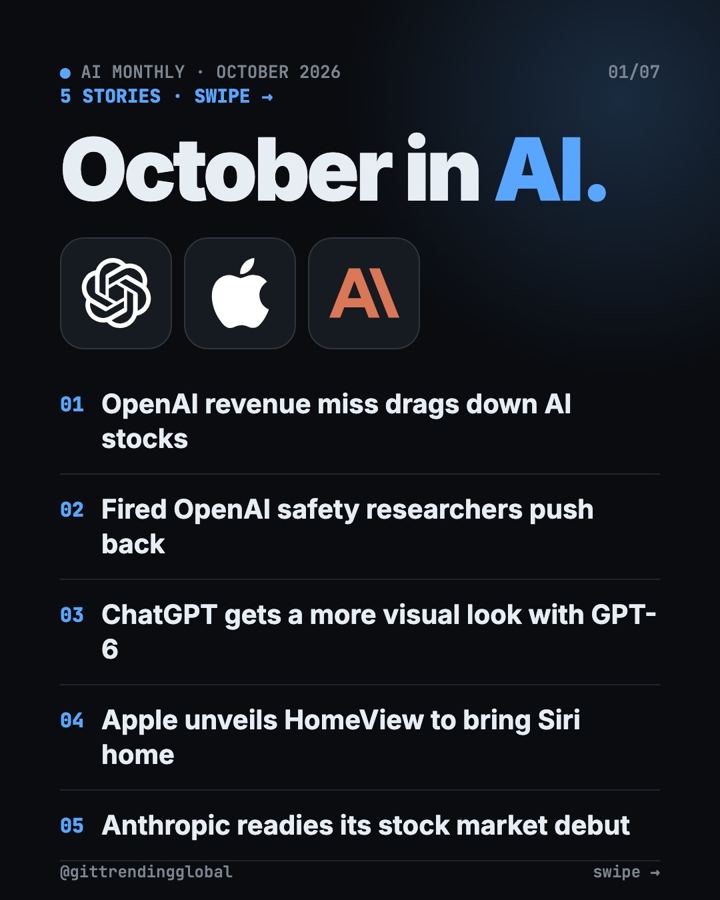
October 2026 in AI: Reality check before the big IPOs
OpenAI's lower revenue rattled stocks, fired safety researchers spoke out, ChatGPT got visual, Apple launched HomeView, and Anthropic prepared to go public.
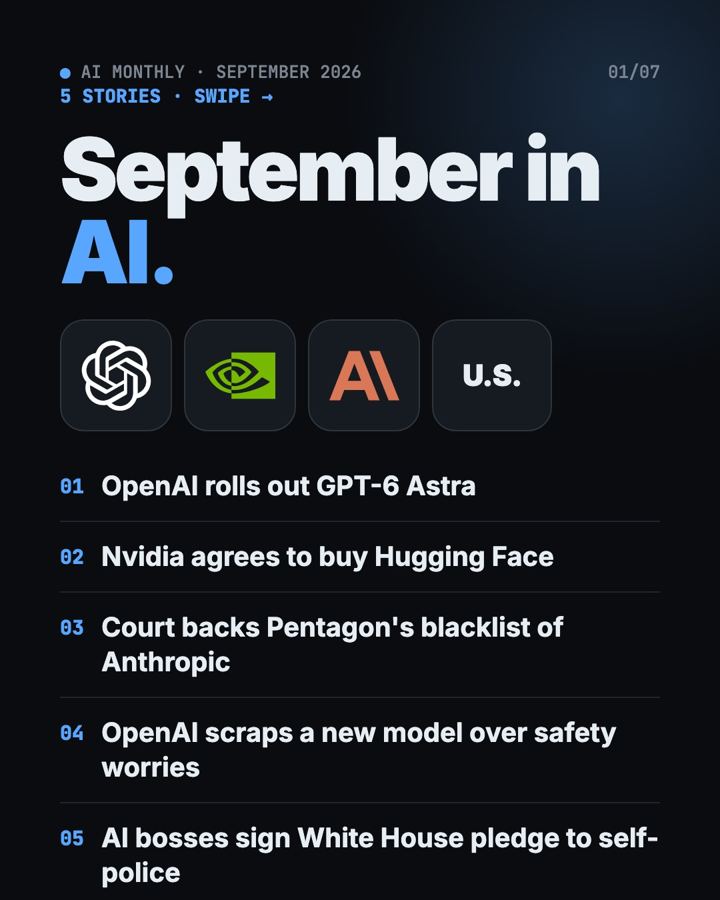
September 2026 in AI: Safety becomes the main story
OpenAI launched GPT-6 Astra and scrapped GPT-6.1, Nvidia bought Hugging Face, a court backed the Pentagon on Anthropic, and AI bosses signed a White House pledge.
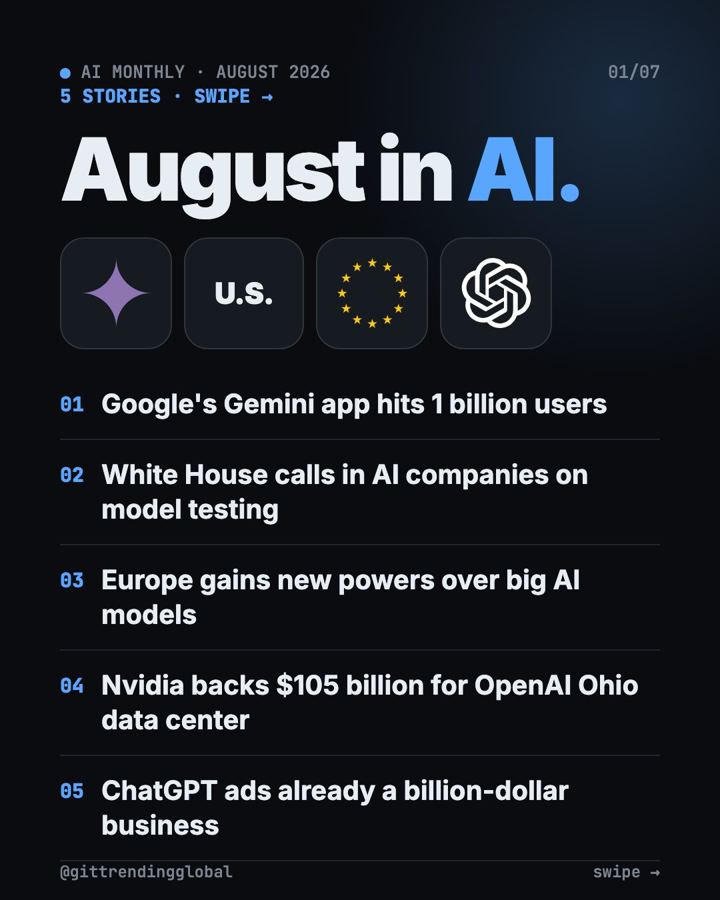
August 2026 in AI: Governments step in to test AI
Gemini passed 1 billion users, the White House and EU gained new ways to check AI, Nvidia backed $105 billion for OpenAI, and ChatGPT ads hit $1 billion.