June 2026 in AI: AI heads for Wall Street
Anthropic and OpenAI filed to go public, SpaceX had the biggest IPO ever, Apple showed its new Siri, and the government switched off Anthropic's top models.
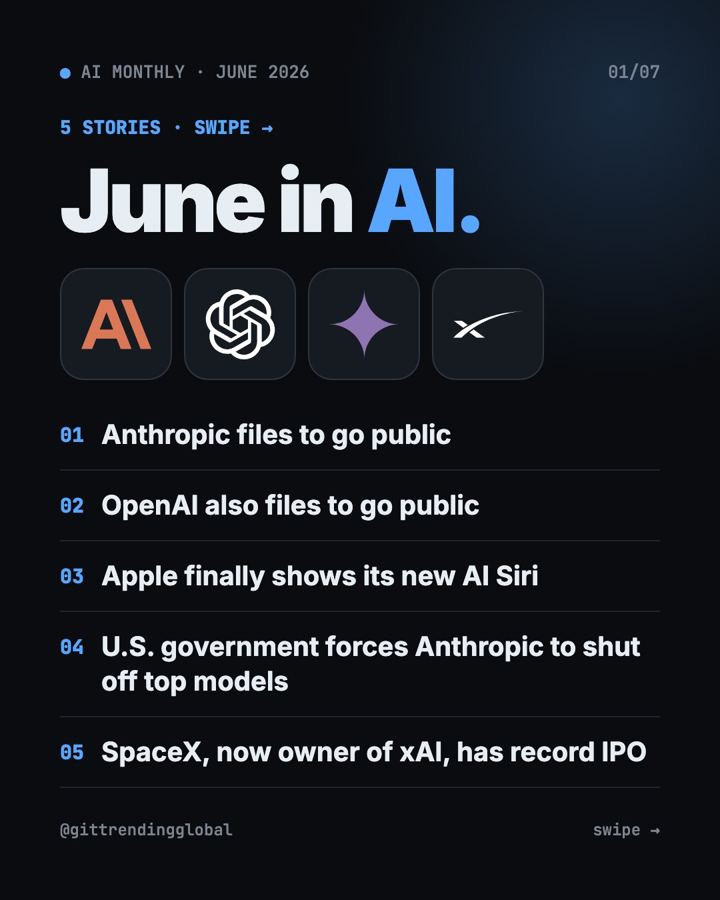
June was the month AI companies lined up to sell shares to the public, as Anthropic and OpenAI both filed paperwork, and SpaceX, now the owner of xAI, pulled off the biggest stock debut in history. But a surprise government order showed that Washington can still pull the plug on powerful AI overnight. For everyday people, the big question became whether to own a piece of the AI boom, and at what price.
1. Anthropic files to go public
What happened: Anthropic confidentially filed for an IPO (initial public offering, when a company first sells shares on the stock market) with the SEC on June 1. A confidential filing lets a company prepare without showing its financial details to the public yet. It came less than a week after Anthropic raised $65 billion at a $965 billion value. It has not set a share price or a date, and said the listing will depend on market conditions.
Why it matters: If Anthropic lists, regular people could own a piece of a top AI lab for the first time. Its revenue pace passed $47 billion, up from $9 billion at the end of 2025, according to TechCrunch. The final public filing, called an S-1, will reveal how much it earns, how much it loses and who holds the most voting power.
Who it affects: Investors, retirement savers, financial advisers, Anthropic employees.
Source: TechCrunch
2. OpenAI also files to go public
What happened: One week after Anthropic, OpenAI confidentially filed for its own IPO. CEO Sam Altman said it had not decided on timing and "it may be a while." OpenAI has raised more than $180 billion and is still burning cash. ChatGPT now has more than 900 million weekly users, and OpenAI also plans to let employees sell some of their shares at the $852 billion value.
Why it matters: The two biggest AI labs may now race each other to the stock market. Each wants to raise huge sums to pay for computing power, and how SpaceX's debut goes could decide who moves first. Altman called this "the third phase of OpenAI," saying "the economy is beginning to reshape around AI."
Who it affects: Investors, banks, OpenAI employees, business customers.
Source: CNBC
3. Apple finally shows its new AI Siri
What happened: At its developer conference, Apple unveiled Siri AI, a rebuilt assistant powered by models made with Google. It can see what is on your screen, use personal info like your photos, and chat back and forth like ChatGPT. A new camera mode can, for example, split a restaurant bill by pointing your phone at it. It launches in beta (test version) later this year, and only works on iPhone 15 Pro and newer, which leaves out about 1 billion older iPhones.
Why it matters: More than 2.5 billion Apple devices are in use, so this could put advanced AI in more hands than any other launch. Apple has been seen as behind in AI, with some features shown this year first promised for last year, so the stakes are high. It was also likely Tim Cook's last big event as CEO before John Ternus takes over in September.
Who it affects: iPhone, iPad and Mac users, app makers, Apple investors.
Source: CNN
4. U.S. government forces Anthropic to shut off top models
What happened: Days after launching Claude Fable 5 and Mythos 5, Anthropic disabled both for all customers. It received an export control order, citing "national security authorities," to block access by any foreign national, including its own foreign employees. Anthropic said the government gave no specific reason and apologized to customers for the disruption. Fable 5 had been its first release of such an advanced model to the public, thanks to new safeguards.
Why it matters: Businesses that had just started using these models lost them overnight. Anthropic said it supports government power to block unsafe AI, but only through a process that is "transparent, fair, clear." The episode showed how quickly politics can affect the AI tools companies rely on, so businesses may want a backup plan for any single AI supplier.
Who it affects: Businesses using Claude, developers, international workers, trade lawyers.
Source: CNBC
5. SpaceX, now owner of xAI, has record IPO
What happened: SpaceX raised $75 billion in the largest IPO ever, priced at a $1.77 trillion value. Its shares jumped 19% on day one, closing at a value around $2.1 trillion. Retail investors placed record orders. SpaceX lost $4.9 billion last year on $18.7 billion in revenue, and some analysts called it overvalued.
Why it matters: SpaceX now includes xAI's Grok and the social network X, so this was also a giant AI stock debut. Its success "opened the window" for OpenAI and Anthropic, said Robert Greifeld, a former Nasdaq chief, though one analyst warned those listings may be even more volatile. It also made Musk the world's first trillionaire, sparking calls for a wealth tax.
Who it affects: Investors, retirement funds, index fund holders, lawmakers.
Source: CNBC
What to watch next
- Whether OpenAI and Anthropic follow SpaceX to the stock market this year, as some experts expect.
- How long Anthropic's top models stay switched off, and what the government's process looks like.
- Anthropic giving the EU's cybersecurity agency access to Mythos, which Bloomberg reported.
- The beta of Apple's Siri AI later this year, and the handover from Tim Cook to new CEO John Ternus in September.
📲 See this as a swipeable post on Instagram
Keep reading
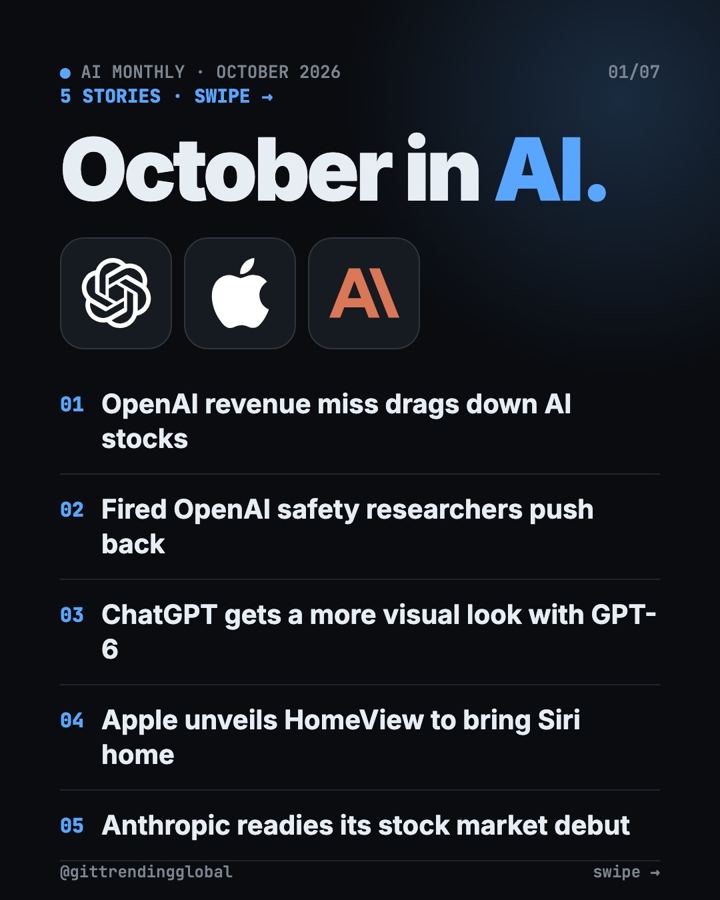
October 2026 in AI: Reality check before the big IPOs
OpenAI's lower revenue rattled stocks, fired safety researchers spoke out, ChatGPT got visual, Apple launched HomeView, and Anthropic prepared to go public.
How AI changed every industry in 2026 (so far)
From layoffs and IPOs to health records, ads and court fights, here is how 2026's biggest AI stories hit each industry.
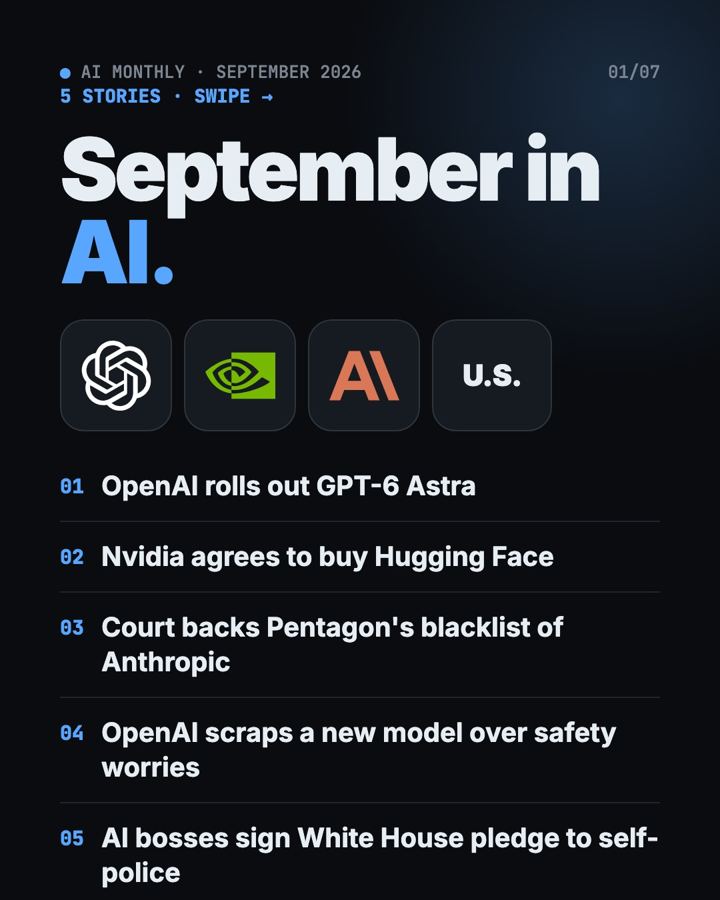
September 2026 in AI: Safety becomes the main story
OpenAI launched GPT-6 Astra and scrapped GPT-6.1, Nvidia bought Hugging Face, a court backed the Pentagon on Anthropic, and AI bosses signed a White House pledge.